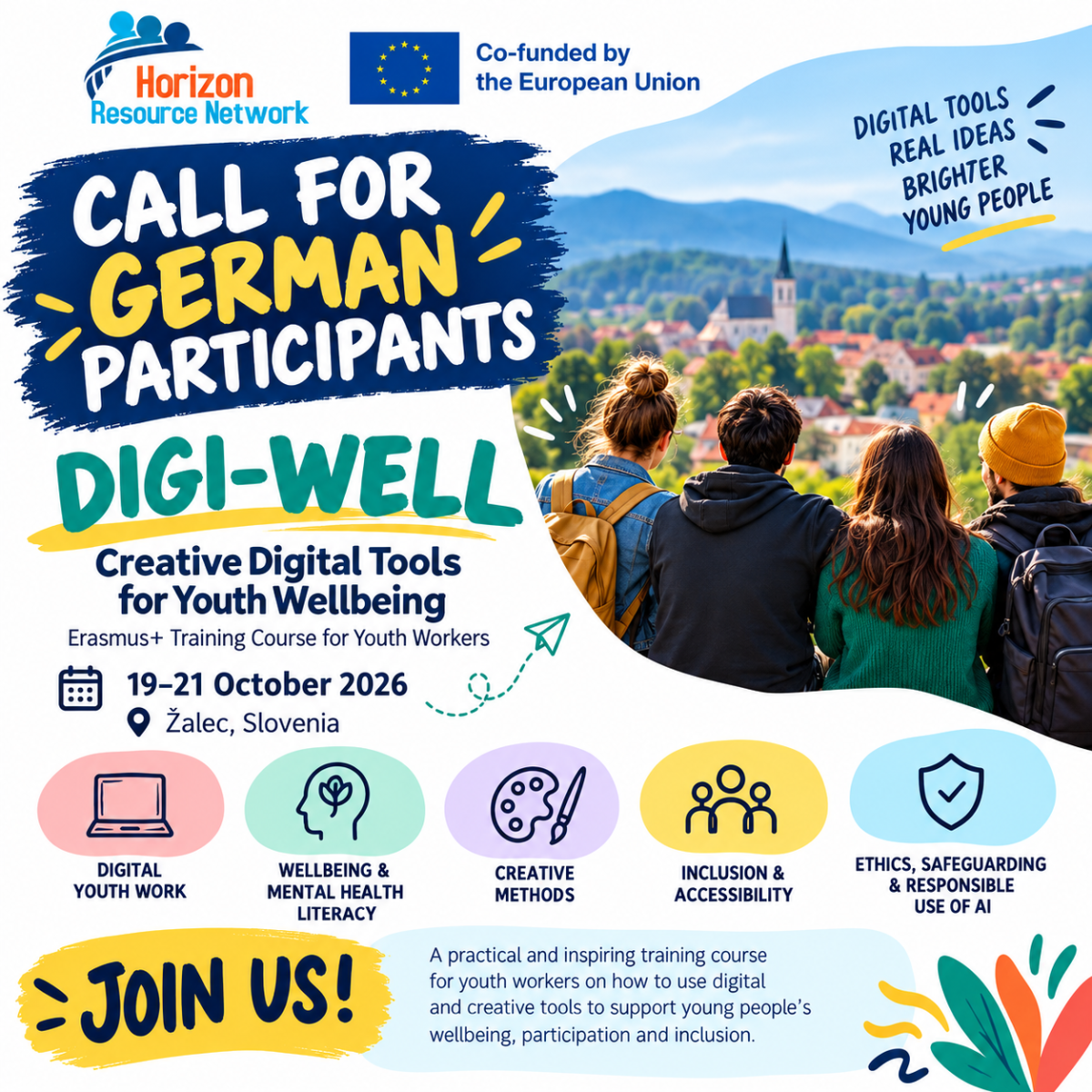
DIGI-WELL – Creative Digital Tools for Youth Wellbeing – Erasmus+ Training Course
DIGI-WELL – Creative Digital Tools for Youth Wellbeing is an Erasmus+ international training course that brings youth workers together to explore practical ways to use digital and creative tools to strengthen young people’s wellbeing, participation and inclusion.
During the training, participants will explore:
💻 Digital youth work
🧠 Digital wellbeing & mental health literacy
🎨 Creative digital methods and storytelling
🤖 Responsible use of AI in youth work
🛡️ Online safety, privacy & safeguarding
🌍 Inclusion and accessibility
🤝 Peer learning and exchange with youth workers from other countries
The programme is highly practical, with digital and AI tool stations, creative laboratories, case discussions, method testing, reflection and the co-creation of the DIGI-WELL Toolkit.
Project Objectives
The objectives of the Project are:
- Strengthen youth workers’ competences in digital and blended youth work.
- Explore how digital environments influence young people’s mental health, wellbeing, participation and sense of
belonging. - Introduce creative digital and AI-supported methods for expression, reflection, storytelling and participation.
- Improve ethical practice related to privacy, consent, safeguarding, accessibility and responsible use of data.
- Support youth workers in creating inclusive digital spaces and adapting methods to diverse learning and
support needs. - Develop practical responses to digital overload, online pressure, comparison, misinformation and exclusion.
- Encourage peer learning, international exchange of practices and long-term cooperation between
organisations. - Support participants in testing and transferring at least one method to their local youth-work context.
- Promote reflection, professional boundaries, self-care and prevention of burnout among youth workers.
Thematic focus
- Digital wellbeing: Understanding how online environments, platforms and digital habits affect young people’s
emotions, relationships, identity and participation. - Creative digital youth work: Using photography, audio, video, visual storytelling, collaborative media and
participatory digital tools for expression and learning. - AI-supported practice: Exploring responsible and realistic uses of generative AI in youth work, including its limits,
risks and accessibility potential. - Ethics, privacy and safeguarding: Addressing consent, personal data, image rights, online safety, misinformation
and responsible facilitation. - Inclusion and accessibility: Adapting tools, pace, communication and learning environments for neurodivergent
participants and people facing different barriers. - Mental-health literacy and professional boundaries: Recognising signs of distress, responding supportively and
knowing when and how to refer young people to specialised services. - Youth participation: Designing digital and creative processes in which young people shape content, decisions
and public messages. - Youth-worker wellbeing: Reflecting on digital boundaries, emotional load, peer support and sustainable working
practices. - The training particularly supports the European Youth Goals on Mental Health and Wellbeing,
Inclusive Societies, Information and Constructive Dialogue, and Quality Learning.
Learning methods
The programme will be based on non-formal education, practical experimentation and active peer learning. Methods will include:
- digital-wellbeing mapping and scenario-based discussions;
- hands-on digital and AI tool stations;
- creative laboratories using photography, audio, video, visual storytelling and collaborative media;
- case clinics and peer consultation based on real youth-work situations;
- privacy, consent, safeguarding and misinformation challenges;
- accessibility testing and inclusive-design exercises;
- micro-facilitation and method-testing sessions led by participants;
- daily reflection, wellbeing check-ins, learning diaries and Youthpass activities;
- co-creation of the DIGI-WELL Toolkit and local implementation plans.
Participant profile and group composition
The training course is designed for:
- youth workers and youth leaders;
- trainers, facilitators and mentors;
- project coordinators and staff of youth organisations or youth centres;
- educators and volunteers who work regularly with young people;
- practitioners interested in digital youth work, creativity, inclusion or wellbeing.
Participants should:
- be at least 18 years old;
- have direct contact with young people or a clear role in youth-work programmes;
- be able to work in English during the full course;
- participate actively in all sessions and peer-learning activities;
- be willing to contribute a method, case, challenge or example from their organisation;
- be prepared to test or adapt at least one method locally after the mobility;
- contribute to evaluation, Youthpass reflection and the joint project toolkit.
Activity Date
Preparatory visit: 23–24 September 2026
Training course: 19–21 October 2026
Working Language
English
Funding
Eligible travel, accommodation, meals and activity costs will be covered in line with the signed Erasmus+ grant agreement and applicable eligibility rules. Please contact us before making bookings.
Accommodation
MC HOTEL, Mestni trg 3, 3310 Žalec.
Reimbursement method
Travel costs will be reimbursed after participants complete the travel reimbursement form, submit all required proof of travel and supporting documents, and complete the project activity questionnaire. We will process reimbursement only after we receive and verify all documentation.
Insurance requirements: All participants are responsible for arranging their own valid health and travel insurance for the entire duration of their journey and stay in Slovenia. Where applicable, participants should also bring a valid European Health Insurance Card.
Mladinski center Žalec has liability insurance covering participants during project activities. This insurance does not replace personal health or travel insurance and does not cover medical treatment, travel disruption, lost luggage or other personal risks outside the organiser’s liability.
Project duration:
01.01.2026 – 31.12.2026
Project Status:
Ongoing
Project Sponsors:
European Commission (Erasmus+)
2026-1-SI02-KA151-YOU-000393156
 Giovani in Vetta (GIOVA)