
Published on August 12, 2026
The Table That Unites Us
Why shared cooking is one of the most powerful — and most underrated — tools for fighting loneliness, bridging cultures, and building the communities we all need.
Food is the oldest form of diplomacy. Long before there were institutions, programmes, or policy frameworks for integration, there was the shared meal — and it worked.
Every culture on earth has a tradition of welcoming strangers with food. The open table, the extra portion, the insistence that you eat before you leave — these are not incidental customs. They are the architecture of human belonging, built over thousands of years of understanding that something fundamental happens when people break bread together.
And yet, in an era of growing migration, urban loneliness, and social fragmentation, we have largely forgotten this. Integration has become a bureaucratic project — language tests, residence permits, employment programmes. Necessary, yes. But insufficient. Because the deepest form of belonging cannot be administered. It has to be felt. And it is most often felt, for the first time, around a table.
Loneliness is Europe's Quiet Epidemic
Across Europe's cities, millions of people live in a condition of profound social isolation. Among migrants and refugees, this isolation is particularly acute. Arriving in a new country — with a new language, unfamiliar systems, and few or no personal connections — can be an experience of almost total disconnection from the human world around you.
The consequences are severe and well-documented. Social isolation increases the risk of depression, anxiety, and physical illness. It erodes people's sense of agency and self-worth. It makes learning a new language harder, finding employment harder, building a life harder. And crucially, it prevents the kind of cross-cultural encounters that make genuine integration — not just formal inclusion — possible.
The saddest part is that many of the people most affected by this isolation live surrounded by others. They walk the same streets, use the same transport, shop in the same supermarkets. But they remain invisible to each other — strangers in proximity, never quite neighbours.
"Loneliness is not the absence of people. It is the absence of connection. And connection begins not with programmes, but with presence — with sitting down, with someone, and sharing something real."
— Community Development PerspectiveThe Science and Soul of the Shared Meal
There is something remarkable about what happens when people cook and eat together. It is not merely symbolic — it is neurological. Sharing food triggers the release of oxytocin, the same bonding hormone released between parents and newborns, between friends who laugh together, between people who trust each other. The shared meal is, at a biological level, a mechanism for creating attachment.
But food does something else that formal integration programmes often cannot: it dissolves hierarchy. At the table, it does not matter what your visa status is, how good your German is, or what job you do. What matters is what is in the pot, and whether you are hungry. That radical equality — temporary, perhaps, but real — creates the conditions for genuine encounter.
Neurological Bonding
Shared eating triggers oxytocin release, the same chemical that creates trust and attachment between people.
Language Without Words
Cooking together creates communication that transcends language — gestures, tastes, laughter all serve as bridges.
Cultural Pride
Sharing one's cuisine is an act of cultural pride and visibility — it says: my heritage is valuable and worth knowing.
Equal Ground
The kitchen is one of the few spaces where social status, legal status, and language ability all momentarily step aside.
Food also carries identity. For migrants and refugees, cooking a dish from home is an act of cultural preservation — a way of saying: I am still myself, even here. Sharing that dish with others is something even more powerful: an invitation into one's world, an act of trust, and a declaration that one's culture is worth knowing.
When someone from Ghana teaches a group of Germans and Vietnamese how to make puff-puff, or a Mexican chef guides a room of internationals through guacamole, something quietly extraordinary happens. Stereotypes soften. Curiosity replaces distance. And the person who arrived as a stranger leaves as — at the very least — a face with a name and a story.
Integration Happens Between People, Not in Offices
We need to be honest about what integration programmes can and cannot do. They can teach language, navigate bureaucracy, provide legal support, and open pathways to employment. All of this is essential. But integration — in its deepest sense — is not something that can be delivered by a programme. It happens in the spaces between people. It happens when a newcomer is genuinely welcomed into the life of a community, not managed into compliance with its systems.
This is the gap that community cooking fills. It is not a replacement for formal support structures — it is the human connective tissue that makes those structures meaningful. A person who has sat around a table with twenty neighbours, who has cooked together and eaten together and laughed together, is a person who has a stake in their neighbourhood. Who has faces to recognise on the street. Who has, in some small but real way, arrived.
Integration is not a document. It is a feeling.
The moment a newcomer feels genuinely at home in their city will not be marked by the issuance of a residence permit or the passing of a language exam. It will be marked by something much quieter — a moment of real connection with another human being. Community cooking creates the conditions for those moments to happen.
What Happens When the World Cooks Together
Consider what it means to gather people from Germany, Nigeria, Iran, Vietnam, Brazil, Ghana, Mexico, and India in a single kitchen. On paper, the differences are vast — language, religion, culture, history, legal status. In the kitchen, those differences become a resource. Everyone knows something the others do not. Everyone has a technique, a spice, a memory attached to a dish that no one else in the room has encountered before.
This is the paradox of culinary diversity: the things that make us most different — our food traditions — are also the things that make us most interesting to each other. You do not need to share a language to be fascinated by how someone else makes bread. You do not need to share a background to enjoy eating something you have never tasted before. Food turns difference from a barrier into an invitation.
What we have witnessed in our own kitchen
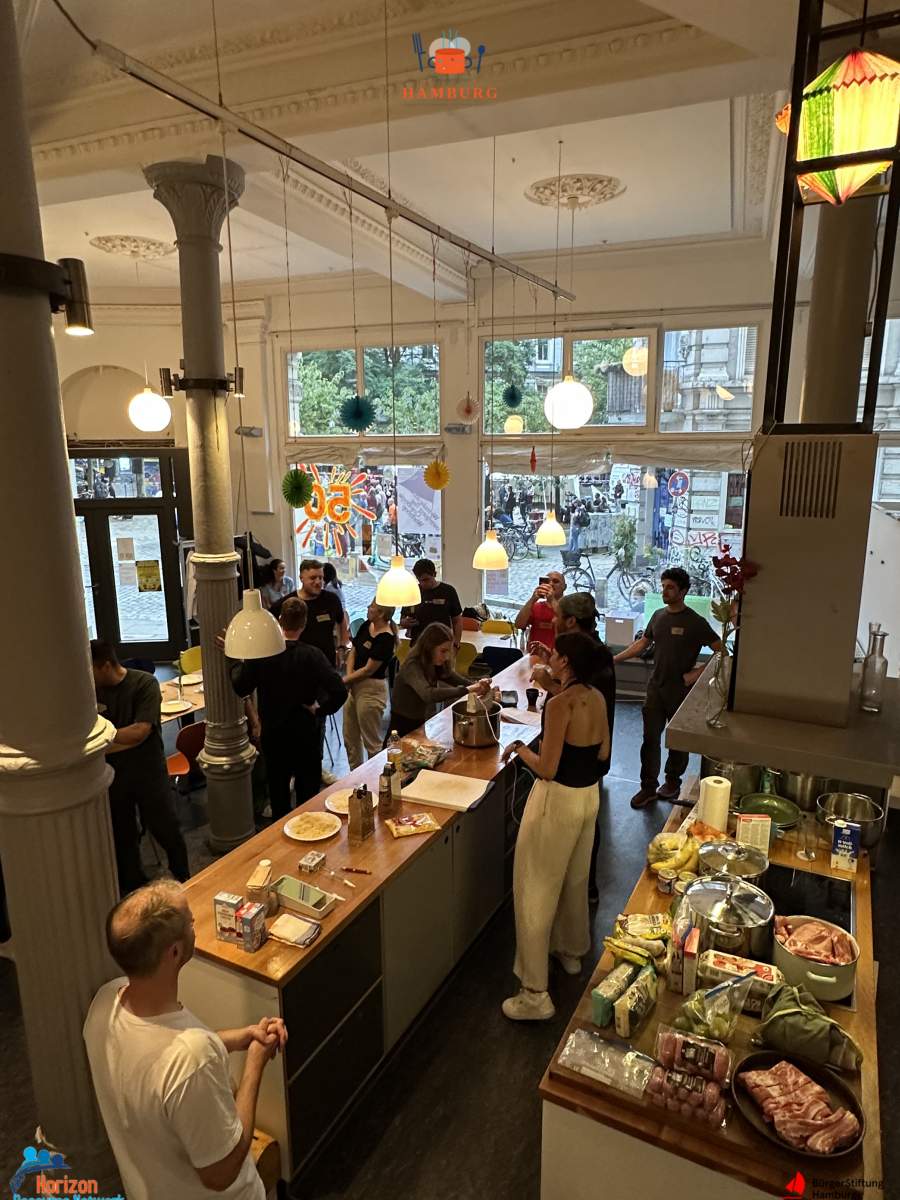
Through our community cooking sessions in Hamburg, we have seen this dynamic play out dozens of times. Participants who arrived quietly and separately, unsure of what to expect, leave with phone numbers saved and plans to meet again. People who have lived in Hamburg for years but felt peripheral to its social life discover, over a shared pot, that they have more in common with their neighbours than they had imagined. The feedback we consistently receive is not about the food — it is about the feeling. The feeling of being welcomed. Of being seen. Of belonging.
Every City Needs a Table Like This
Community cooking is not a new idea. Across the world, in refugee centres and neighbourhood halls, in church kitchens and community gardens, people have been using food to build community for as long as there have been communities. What is new is the urgency — and the opportunity to do it intentionally, at scale, as a recognised tool for social cohesion.
Cities are becoming more diverse at a pace that formal integration infrastructure cannot keep up with. The gap between people who are legally included and people who feel genuinely at home is growing. Filling that gap requires approaches that are human in scale, accessible without qualification, and capable of creating real connection — not just managed coexistence.
Community cooking is one of those approaches. It is cheap to run, easy to replicate, and its impact — measured not in outputs but in the quality of human connection it produces — is profound. Every city that is serious about integration should have a table like this. And every table like this needs people willing to sit down at it.
"Tell me what you eat and I will tell you who you are — but sit down and eat with me, and we will both discover something new."
— After Brillat-SavarinThe table is already set. The only question is whether we are willing to pull up a chair — and pass the pot to the person sitting next to us.
Join us at the table.
Flavours of Hamburg brings people together through food every month in Hamburg. Whether you want to participate, volunteer, or support — there is a place for you.
Find Out More