
Published on February 19, 2026
Germany’s increasingly diverse society has brought greater attention to the everyday realities migrants face. Beyond overt discrimination, many migrants experience subtle forms of bias known as microaggressions. While often dismissed as minor, research shows these repeated experiences can significantly affect both mental and physical health.
A recent study of migrants in Germany, conducted in partnership with our academic partners, sheds new light on the role of psychological capital—and why strengthening individuals alone is not enough to protect migrant well-being.
What Are Microaggressions?
Microaggressions are subtle, often unintentional comments or behaviors that communicate exclusion, bias, or negative assumptions about someone’s background.
Common examples include:
-
Being repeatedly asked where you are “really from.”
-
Assumptions about competence based on accent or origin
-
Dismissing or minimizing experiences of discrimination
Over time, these experiences accumulate. Research shows they can increase stress, reduce self-esteem, and contribute to depression and physical health complaints among migrants.
Why Migrant Health in Germany Deserves Attention
Germany is one of Europe’s major destination countries for migrants. While integration policies have expanded, many migrants still report barriers in:
-
healthcare access
-
employment
-
education
-
social inclusion
These structural and interpersonal challenges create a context where microaggressions can quietly but consistently undermine well-being.

Understanding Psychological Capital (PsyCap)
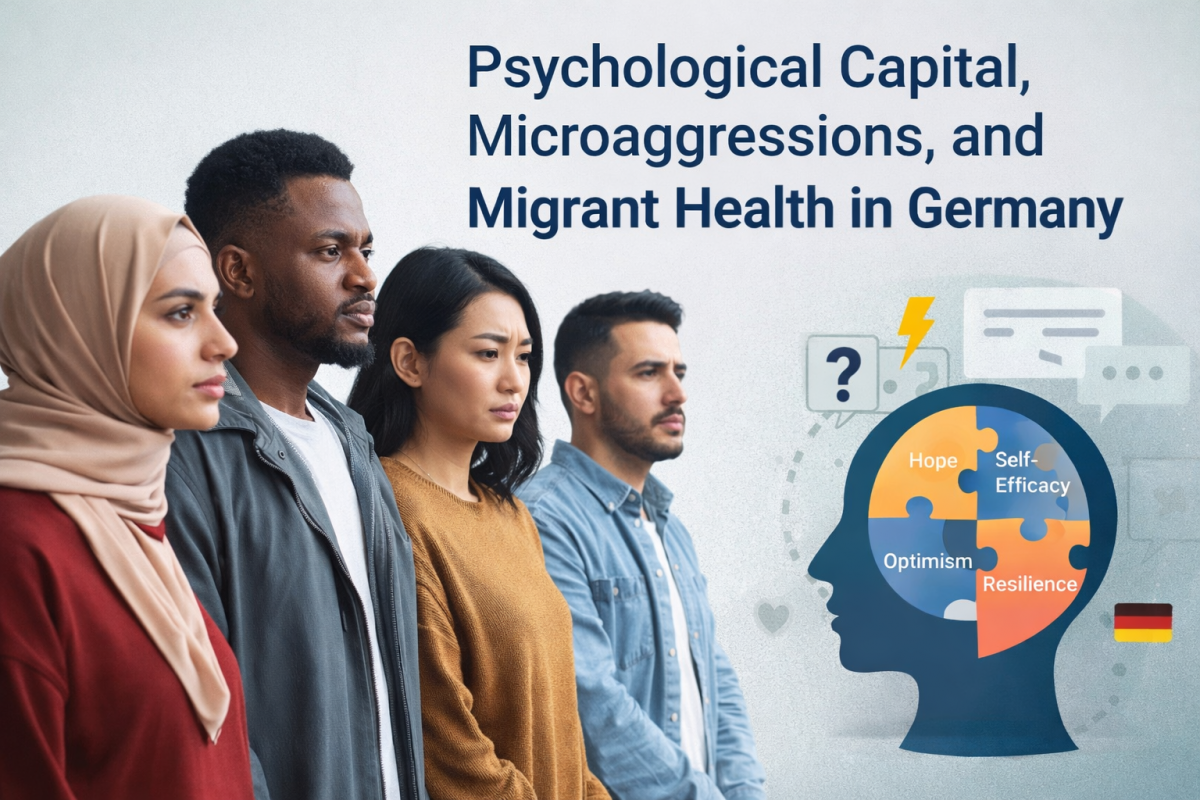
Psychological capital refers to a set of positive psychological resources that support coping and performance:
-
Hope – ability to pursue goals
-
Self-efficacy – confidence in one’s abilities
-
Resilience – the capacity to bounce back
-
Optimism – positive expectations for the future
These resources are often promoted in migrant empowerment and integration programs — and for good reason. Higher psychological capital is generally linked to better mental and physical health.
But the new evidence shows the relationship is more complex than previously assumed.
Key Finding #1: Microaggressions Harm Migrant Health
The study of 858 migrants across Germany found a clear pattern:
-
More perceived microaggressions → worse mental health
-
More perceived microaggressions → worse physical health
These effects remained significant even after controlling for demographic factors.
Key Finding #2: Psychological Capital Partly Explains the Impact
One of the strongest findings is the mediating role of psychological capital.
The data showed:
-
Microaggressions significantly reduced psychological capital
-
Lower psychological capital predicted poorer mental and physical health
-
Psychological capital partially explained how discrimination affects health
What this means
Repeated subtle discrimination drains migrants’ internal coping resources. When hope, resilience, optimism, and self-efficacy decline, health outcomes worsen.
For practitioners, this confirms that building psychological capital remains an important protective strategy — but it is only part of the solution.
Key Finding #3: Psychological Capital Does Not Always Buffer Harm
Here is the most surprising result.
Many programs assume resilience and optimism will protect migrants from the effects of discrimination. However, the moderation analysis revealed something more nuanced:
-
Higher psychological capital was generally linked to fewer depressive symptoms
-
But among migrants with higher PsyCap, microaggressions were more strongly associated with depression
-
Psychological capital did not buffer physical health effects
Possible explanation
Researchers suggest several mechanisms:
-
Higher PsyCap may raise expectations of fairness
-
Violations of these expectations may feel more harmful
-
Highly engaged migrants may face greater exposure to bias
-
Continuous coping effort may lead to “resilience fatigue.”
Bottom line: Personal resilience cannot fully compensate for discriminatory environments.
What This Means for Integration and Health Policy in Germany
The evidence points to a dual strategy.
✔ Strengthen psychological resources
Effective interventions include:
-
resilience training
-
optimism and hope development
-
self-efficacy workshops
-
peer support programs
-
culturally sensitive counselling
These help migrants maintain mental well-being and adaptive coping.
✔ Address structural and interpersonal discrimination
Equally important are system-level actions:
-
explicit recognition of microaggressions in policy
-
anti-racism and cultural competence training
-
inclusive workplace and education practices
-
accessible migrant-friendly mental health services
Without structural change, individual resilience efforts will have limited impact.
Practical Implications for Organizations Working With Migrants
For NGOs, training providers, and youth mobility programs in Germany, the research is highly actionable.
High-impact steps:
-
Integrate psychological capital development into training programs
-
Train staff to recognize and respond to microaggressions
-
Create psychologically safe learning environments
-
Validate migrant lived experiences
-
Combine empowerment programs with advocacy for inclusion
Organizations that work at both the individual and systemic levels will see the strongest outcomes.
Final Takeaway
Microaggressions are a real and measurable driver of migrant health disparities in Germany. Psychological capital plays an important protective role — but it is not a shield against structural bias.
The most effective path forward is clear:
Build resilient individuals and inclusive systems.
Germany’s long-term social cohesion and migrant well-being depend on both.